


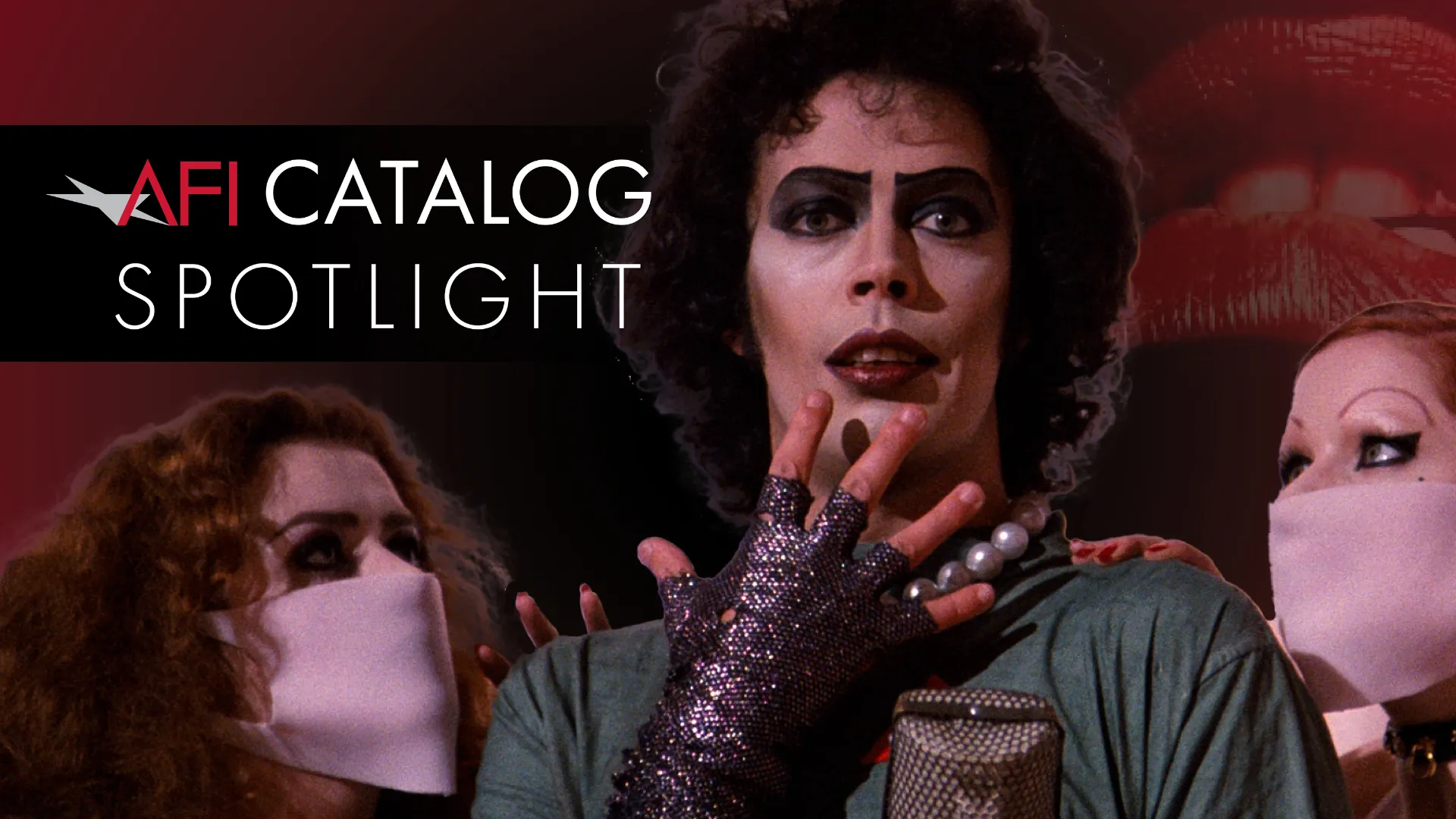
This September, the AFI Catalog celebrates the 50-year release anniversary of the quintessential glam rock cult classic THE ROCKY HORROR PICTURE SHOW (1975), which remains the longest-running movie of all time as it continues to be in limited release to this day at midnight screenings worldwide. Directed by Australian filmmaker Jim Sharman, who co-wrote the screen adaptation of the 1973 musical ”The Rocky Horror Show” with its original author and songwriter, Richard O’Brien, THE ROCKY HORROR PICTURE SHOW was initially deemed to be a critical and box-office flop despite its low budget of roughly $1.5 million and its widespread success on the stage.[i] But the movie, a parody of classic Hollywood horror flicks and a transgressive exploration of gender norms and sexuality, gained traction as a cultural phenomenon in ways that had rarely been seen before in film history, with live audiences performing alongside the screen adorned in homespun costumes, flaunting a variety of fetishes and props.THE ROCKY HORROR PICTURE SHOW’s anti-establishment celebration of queer culture and its dismantling of tired tropes about the American Dream provided “safe spaces” for people who identified as outsiders and iconoclasts, particularly those in the LGBTQ+ community.[ii] By talking back to the film and inserting themselves into the narrative, fans were empowered to take possession of the experience and express their own personal authenticity as it related to the movie, a rare occurrence in cinema reception unique to THE ROCKY HORROR PICTURE SHOW.
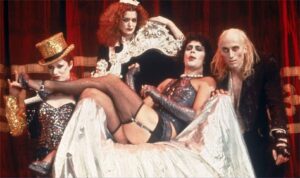
British-New Zealand performer Richard O’Brien, who played the role of Riff Raff both in the movie and the stage production, started his career as a stuntman and had roles in the early 1970s English theatrical presentations of HAIR – which also included ROCKY HORROR star Tim Curry – and “Jesus Christ Superstar,” which was directed by Jim Sharman.[iii] O’Brien left the company of “Jesus Christ Superstar” in 1972 and devoted his time to composing a rock musical, then called ”They Came from Denton High,” as an homage to Universal-International’s first 3-D sci-fi flick from 1953, IT CAME FROM OUTER SPACE.[iv] The title changed to ”The Rocky Horror Show before landing on ”The Rocky Horror Show,” and, with the input of Jim Sharman and British producer Michael White, the musical premiered in London in June 1973 at the Royal Court Theatre’s experimental Theatre Upstairs, starring Tim Curry (Dr. Frank-N-Furter), Richard O’Brien (Riff Raff), Patricia Quinn (Magenta) and Little Nell (Columbia), who would all reprise their roles in the movie. The triumph of ”Rocky Horror” on stage resulted in the show moving to larger venues and proved to be an extremely popular attraction in London.
Ticket sales were further bolstered by the positive reception of celebrity audience members including Mick Jagger (who later made an unsuccessful bid to play the lead role of Dr. Frank-N-Furter in the movie), David Bowie, Lou Reed and notably actress Britt Ekland – who introduced the musical to her partner Lou Adler, an American music and film producer. Within days of seeing the show, Lou Adler negotiated a deal with Michael White to bring “Rocky Horror” to Adler’s Hollywood club, The Roxy, where it played to sold out crowds for nine months straight.[v] Riding high on the triumph of his acquisition, Adler convinced 20th Century Fox executive Gordon Stulbert to see the show with his teen sons, and Stulbert in turn agreed to support a film adaptation with an initial $1 million budget.[vi]
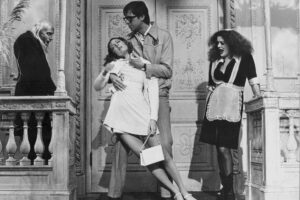
Filming started in late October 1974 and took place over eight weeks at Bray Studios in England. Locations were shot at Oakley Court, a Victorian mansion that once provided a base for horror movie producer Hammer Films before the company moved to Bray Studios, lending an immediate allusion to the history of the genre. Shortly after the film was completed, the stage musical made its premiere on Broadway in March 1975 to generally devastating reviews and audience responses, resulting in malaise at 20th Century Fox about the movie’s impending release.
On September 26, 1975, THE ROCKY HORROR PICTURE SHOW opened in Los Angeles and in seven other cities across the U.S. Although the film did well in LA, it bombed elsewhere, and Fox withdrew it from release. Executives rekindled their hope for the production when they learned that many members of the Los Angeles audience were repeat customers, and plans were made to open ROCKY HORROR as a Midnight Movie at the Waverly Theater in New York’s Greenwich Village on April Fool’s Day, 1976. There, the film made history for continuing its run for nearly 100 weeks, and its success led to midnight screenings on Friday and Saturday nights in other theaters around the country, establishing a new anti-establishment counterculture of movie-viewing practices.
As the 1970s came to a close, THE ROCKY HORROR PICTURE SHOW had demonstrated an incredible comeback with around 200 prints in circulation that grossed more than $5 million each year and resulted in a new franchise of fan clubs, themed products and a hit record album of songs that had a direct influence on the punk rock movement.[vii] [viii] As of 2025, box office reports estimate that the film has earned over $160 million worldwide, or nearly $627 million with ticket prices adjusted for inflation – which warrants its inclusion on accounts of America’s 100 top-grossing movies of all time and ranks its income above revered dramas such as ROCKY (1976) and THE BEST YEARS OF OUR LIVES (1946).[ix] In 2005, the Library of Congress’s National Film Registry selected THE ROCKY HORROR PICTURE SHOW for preservation, a prestigious honor that is bestowed upon only 25 films a year.[x] At a time in which home-based streaming services have widely displaced brick and mortar theaters as the preferred purveyor of motion pictures for today’s audiences, THE ROCKY HORROR PICTURE SHOW continues to necessitate the collective intimacy of experiencing movies in the company of others. With its earnest dedication to celebrating outsiders, the movie’s capacity to engage communities of fans has never ceased to wane through new generations of audiences.
Watch the infamous “Time Warp” scene in this music video:
Watch Tim Curry talk about the making of THE ROCKY HORROR PICTURE SHOW in 1975:
https://www.youtube.com/watch?v=G5sTIGLo79g
RESOURCES
[i] Jeffrey Andrew Weinstock, ed. Reading Rocky Horror: The Rocky Horror Picture Show and Popular Culture. (New York: Palgrave Macmillan), 2008.
[ii] Ann Lee. “’Everybody Was Fondling Underwarter!’: The Rocky Horror Picture Show at 50—An Oral History.” The Guardian, July 31, 2025.
[iii] Weinstock, 2008.
[iv] Scott Miller. Sex, Drugs, Rock & Roll and Musicals. (Boston: Northeastern University Press), 2011.
[v] Weinstock, 2008.
[vi] Jim Whittaker. Cosmic Light: The Birth of a Cult Classic. (Altoona: Acme Books), 1998.
[vii] Weinstock, 2008.
[viii] Miller, 2011.
[ix] “Top Lifetime Adjusted Grosses,” Box Office Mojo, 2025.
[x] Daniel Eagan. America’s Film Legacy: The Authoritative Guide to the Landmark Movies in the National Film Registry. (New York: Continuum), 2010.