


This November, the AFI Catalog celebrates the centennial release anniversary of Oscar Micheaux’s controversial masterpiece BODY AND SOUL (1925), which marked the screen debut of acclaimed singer and stage actor Paul Robeson in his first and only film performance for a Black director. Showcasing the dual role of estranged twin brothers – an escaped convict masquerading as a pastor (Reverend Jenkins) and a kindly but impoverished inventor (Sylvester), both competing for the love of the same woman – Robeson’s characters demonstrated his astonishing range as a performer and propelled him into a career of movie stardom, though he distanced himself from BODY AND SOUL and often cited the 1933 screen adaptation of Eugene O’Neill’s 1920 play “The Emperor Jones” as his first feature.[i] Robeson’s inaugural film acting deal with Micheaux, which was brokered by Robeson’s wife and manager, Eslanda Robeson, nearly a decade before THE EMPEROR JONES (1933) film was released, evidenced a historical shift toward a burgeoning market in America for Black artists and audiences. Eslanda Robeson, a pioneering Black businesswoman, negotiated her husband’s contract, securing a weekly salary of $100 plus a percentage of revenues over $40,000 — an early example of profit participation for a Black artist.[ii] The practice of exchanging a share of a film’s income for labor has since become commonplace.
The Robesons’ gamble on BODY AND SOUL was bold, if not misguided, as the couple likely failed to account for the fact that no Micheaux picture had ever earned as much money, and Micheaux himself was known to be an unreliable accountant.[iii] The Robesons’ faith in BODY AND SOUL was further compromised when the picture generated controversy with white censors for depicting a man of the cloth as a rapist shyster, and denunciation from Black critics for neglecting to uplift the respectability of all African Americans – the main tenet of “race films” – as well as for using offensive racial epithets in the title cards. Micheaux, who famously traveled across the country to personally deliver his films to regional theaters, was eager to get BODY AND SOUL distributed (even internationally) and he agreed to cut scenes identified as objectionable by the New York State Motion Picture Commission, reducing the nine-reel picture to five reels and losing large elements of the original narrative. Historian Charles Musser has argued that Micheaux’s work with BODY AND SOUL was not particularly original, but rather drawn heavily from several plays that had featured Robeson in leading roles, including the stage production of “The Emperor Jones.”[iv] Since censors were most concerned with the film’s “sacrilegious, immoral” representation of the minister performed by Robeson, which they believed would incite lawlessness and violence, Micheaux resolved to portray the Reverend Jenkins character as a spurious imposter, not an actual pastor, thereby bypassing his initial provocative critique of organized religion and transforming the movie into a “moral parable.”[v]
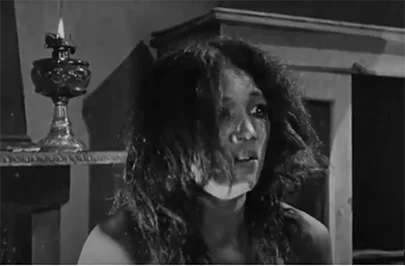 When Micheaux’s edit was again rejected by censors, he whittled the film down further and ingeniously wrapped it up with a new ending that has become a Hollywood trope: the story was just a bad dream after all. The dreamer, Sister Martha (portrayed by the magnificent Mercedes Gilbert in one of her three screen appearances), awakens to reveal that the movie had been entirely in the perspective of her nightmare and that everything in her world remains unscathed, if not ultimately improved. This shift in point of view supports a more feminist reading of the film as it follows the struggles of Sister Martha’s daughter, Isabelle, played by Micheaux’s future real-life sister-in-law Julia Theresa Russell in her first and only motion picture. Micheaux married Alice B. Russell just a few months after the release of BODY AND SOUL, and she worked on many of Micheaux’s productions as an actress, filmmaker and businesswoman. Sister Martha’s terrible dream discloses that Isabelle’s innocence has been violently violated by Reverend Jenkins, who also steals the elder washerwoman’s meager life‘s savings in her Bible and pins the theft on Isabelle. Blinded by faith and her desire for righteousness, Martha sides with the pastor in a stark betrayal of Isabelle’s truth that reflects a widespread silencing of women and other members of society who have been muted to protect the tendentious status quo. Even in its censored form, Micheaux’s narrative — and his steadfast commitment to depicting his story on film — reflects a deliberate challenge to the power systems of his time and a desire to provide a voice to those silenced by the establishment.
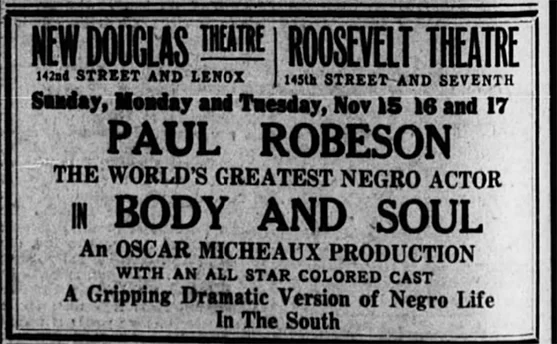 BODY AND SOUL was finally approved for release on November 15, 1925, but Micheaux was not one to be outwitted and he screened the uncut version of BODY AND SOUL at several Harlem theaters before taking it on the road to cities with large Black communities, where it resonated with critics and spectators alike.[vi] As the film circulated across the country, however, audiences took issue with BODY AND SOUL and Micheaux began to lose creative control over his work. Reviews from the time, for example, exposed various discrepancies in the storyline depending on the location of the theater, revealing that BODY AND SOUL was further edited by censors in different cities who took liberties to adjust the narrative to their own liking, and Micheaux was displeased to receive prints of BODY AND SOUL returned to him with missing or destroyed footage.[vii] This sweeping gesture of erasure of Micheaux’s vision and artistic license (no matter how derivative they may have been) prompts speculation today about how his role as an independent Black filmmaker may have impacted his inability to maintain authority over his work at a time when the Hollywood studio system was consolidating corporate control over the movie business. Reflecting on Musser’s contention that BODY AND SOUL was a product of the “uncredited appropriation” of white playwrights, Micheaux’s so-called piracy can also be read as subversive. This was not unlike what would later be known as “sampling” in rap and hip-hop.[viii] It demonstrated the range of Micheaux’s technical capabilities as a seasoned director working on a tight budget and showcased Robeson’s talent, particularly in suspenseful scenes “worthy of early Hitchcock.”[ix]
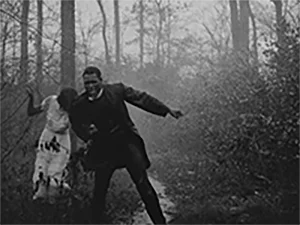 Despite challenges piecing together an “original” cut of BODY AND SOUL due to its precarious origins, the George Eastman Museum restored eight reels of the picture and it was released on a Paul Robeson DVD collection for Criterion in 2007. The nine-reel picture that reflected Micheaux’s initial intent is technically considered lost, but the eight-reel, edited version of BODY AND SOUL remains one of only a few known Micheaux silent pictures that are partially extant.[x] Representing 1920s Black culture at a time when there was very little visual documentation due to social and economic factors, the historical significance of BODY AND SOUL cannot be overstated. Although Micheaux was remarkably prolific, creating about 45 silent and sound films over two decades—few of his works survive today. BODY AND SOUL is believed to be the closest to an intact original – a real irony considering the film’s well-known truncation by Micheaux and his critics.[xi] In 2019, BODY AND SOUL was selected for preservation by the Library of Congress’ National Film Registry, and it has screened at festivals around the world, fulfilling Micheaux’s dream of international distribution. BODY AND SOUL today is in the public domain, freely accessible worldwide on streaming services and video platforms, reminding viewers of how much has changed and how far we have yet to go toward true equality, body and soul.
RESOURCES:
[i] Barbara Ransby. Eslanda: The Large and Unconventional Life of Mrs. Paul Robeson (New Haven: Yale University Press, 2013).
[ii] Ransby, 2013.
[iii] Patrick McGillian. Oscar Micheaux, The Great and Only: The Life of America’s First Black Filmmaker (New York: Harper Perennial, 2007).
[iv] McGillian, 2007.
[v] McGillian, 2007.
[vi] McGillian, 2007.
[vii] McGillian, 2007.
[viii] Charles Musser, “To Redream the Dreams of White Playwrights: Reappropriation and Resistance in Oscar Micheaux’s Body and Soul,” in Oscar Micheaux and His Circle: African-American Filmmaking and Race Cinema of the Silent Era, ed. Pearl Bowser, Jane Gaines, and Charles Musser (Bloomington: Indiana University Press, 2001), 97–131.
[ix] McGillian, 2007.
[x] Maria Lagomarsino, “’A Miniature Replica of Life’: Reality, Critique, and the Burden of Representation in Oscar Micheaux’s Body and Soul” (Master’s thesis, Montclair State University, 2025).
[xi] McGillian, 2007, as cited in Lagomarsino