


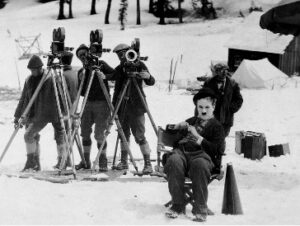
 This month, the AFI Catalog celebrates the 100 year anniversary of Charlie Chaplin’s masterpiece THE GOLD RUSH, which was released nationally on August 16, 1925 after a world premiere in Los Angeles in late June. The film – strikingly Chaplin’s most ambitious picture to date[i]– was a box-office sensation that continues to resonate today as one of the most iconic and lucrative silent films ever made.[ii] Appearing on AFI’s list of the greatest films of all time and on its list of the funniest American movies, THE GOLD RUSH was notable for its length in ten reels, which was unusually long for a comedy at the time, and for its innovative visual effects. THE GOLD RUSH was an international cultural phenomenon – one of the first Hollywood movies to achieve this status – as it spoke to audiences of different languages, backgrounds and social class with its universally relevant humor.[iii] Similar to Chaplin’s character as the lone prospector in THE GOLD RUSH, the film struck gold in its global popularity and marked a new pinnacle in Chaplin’s career, solidifying his legacy as one of the world’s most recognizable comics even to this day.
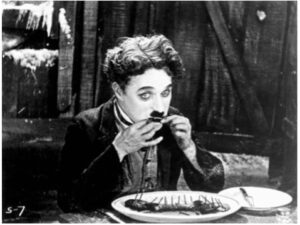
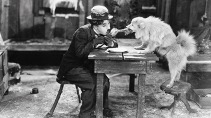
According to Chaplin’s autobiography, THE GOLD RUSH was inspired by a book about the ill-fated Donner Party, a group of pioneers who split off from a larger wagon train traveling to California through the Sierra Nevada mountains in 1846, only to be met by a blizzard that resulted in the death of roughly half the group.[iv] The famous scene in THE GOLD RUSH where Chaplin’s lone prospector character eats his shoe was inspired by accounts of the Donner Party survivors eating their moccasins (they also famously resorted to cannibalism to stay alive).Chaplin was further intrigued by a collection of stereoscope cards that were owned by Douglas Fairbanks, which portrayed the Klondike Gold Rush of 1897-1899.[v]In the opening scenes of THE GOLD RUSH, Chaplin replicated images of the miles-long line of prospectors crossing Alaska’s Chilkoot Pass with nothing else in sight but acres of deep white snow. Shot in the Sierra Nevada near Truckee, California, the sequence required roughly 600 background actors who were reportedly recruited from the community of unhoused men in nearby Sacramento.[vi] Despite Chaplin’s plan to shoot all exteriors on location, very few scenes filmed in Truckee besides this one made it to the final cut of the film, and most of the existing picture was photographed on sets at Chaplin’s studio in Hollywood.[vii]
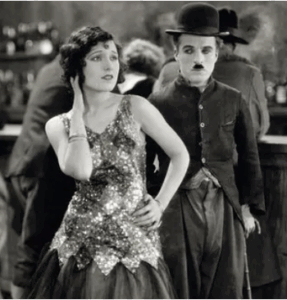
The premise of THE GOLD RUSH was exemplary of Chaplin’s belief that humor represented a twist on real pathos and tragedy, and the film marked one of the only Chaplin pictures that had a fully realized story before shooting began.[viii] After the unsuccessful release of A WOMAN OF PARIS (1923), Chaplin’s first film at United Artists (an independent company he co-founded with in 1919 with D.W. Griffith, Mary Pickford and Douglas Fairbanks to protect artists’ interests) Chaplin was eager to launch a new project and sent the scenario of THE GOLD RUSH (then called LUCKY STRIKE) to be copyrighted just two months after the premiere of A WOMAN OF PARIS.[ix] In addition, THE GOLD RUSH was Chaplin’s first major undertaking to portray a romantic story about the Tramp and his leading lady – in this case, the Tramp’s unrequited love is actually realized at the conclusion of the movie, making the character rich in money as well as in his sweetheart’s affections, a true Hollywood ending.[x] Despite controversy surrounding Chaplin’s romance with his young co-star, Lita Grey, who was later replaced by actress Georgia Hale when Grey discovered she was pregnant, THE GOLD RUSH was a commercial and critical achievement, with Variety calling the comedy “the greatest of all time.”[xi]
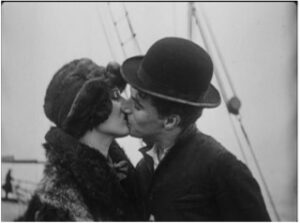
In 1942, Chaplin re-edited THE GOLD RUSH, replacing intertitles with spoken narration (by Chaplin, himself) and adding a musical score. The re-released version of the film marked the first time Chaplin revived one of his silent productions and converted it into sound. It also contained footage shot with a second camera during the original production, which made Georgia Hale’s character appear more adoring of the Tramp earlier in the picture than in the 1925 release. Chaplin additionally changed the last shot of the original movie, in which he and Georgia Hale shared a lingering kiss. In the reissue, the two leading characters, who had a romance onscreen and off, are depicted walking away from the camera holding hands instead of kissing, portraying the relationship with greater austerity. Chaplin’s decision to restore THE GOLD RUSH to movie theaters in 1942 was met with further acclaim, and it was nominated for two Oscars® in the categories of Best Music Score and Best Sound.
As noted in various modern sources, Chaplin was proud of his accomplishments with THE GOLD RUSH and he wanted it to be the film he was remembered by, though he later included other films such as CITY LIGHTS (1931).[xii] In many ways, his wish has come true.
RESOURCES
[i] James L. Neibaur. Early Charlie Chaplin: The Artist as Apprentice at Keystone Studios. Maryland: Scarecrow Press, Inc., 2012.
[ii] Lucy Sante. “The Gold Rush: As Good as Gold,” Criterion Collection: Essays, June 11, 2012.
[iii] Sante.
[iv] The Gold Rush. American Film Institute.
[v] Filming The Gold Rush. CharlieChaplin.com.
[vi] Sante.
[vii] Sante.
[viii] CharlieChaplin.com
[ix] CharlieChaplin.com
[x] Georgia Hale and Heather Kiernan. Charlie Chaplin: Intimate Close-Ups. Maryland: Scarecrow Press, Inc., 1999.
[xi] American Film Institute.
[xii] CharlieChaplin.com