


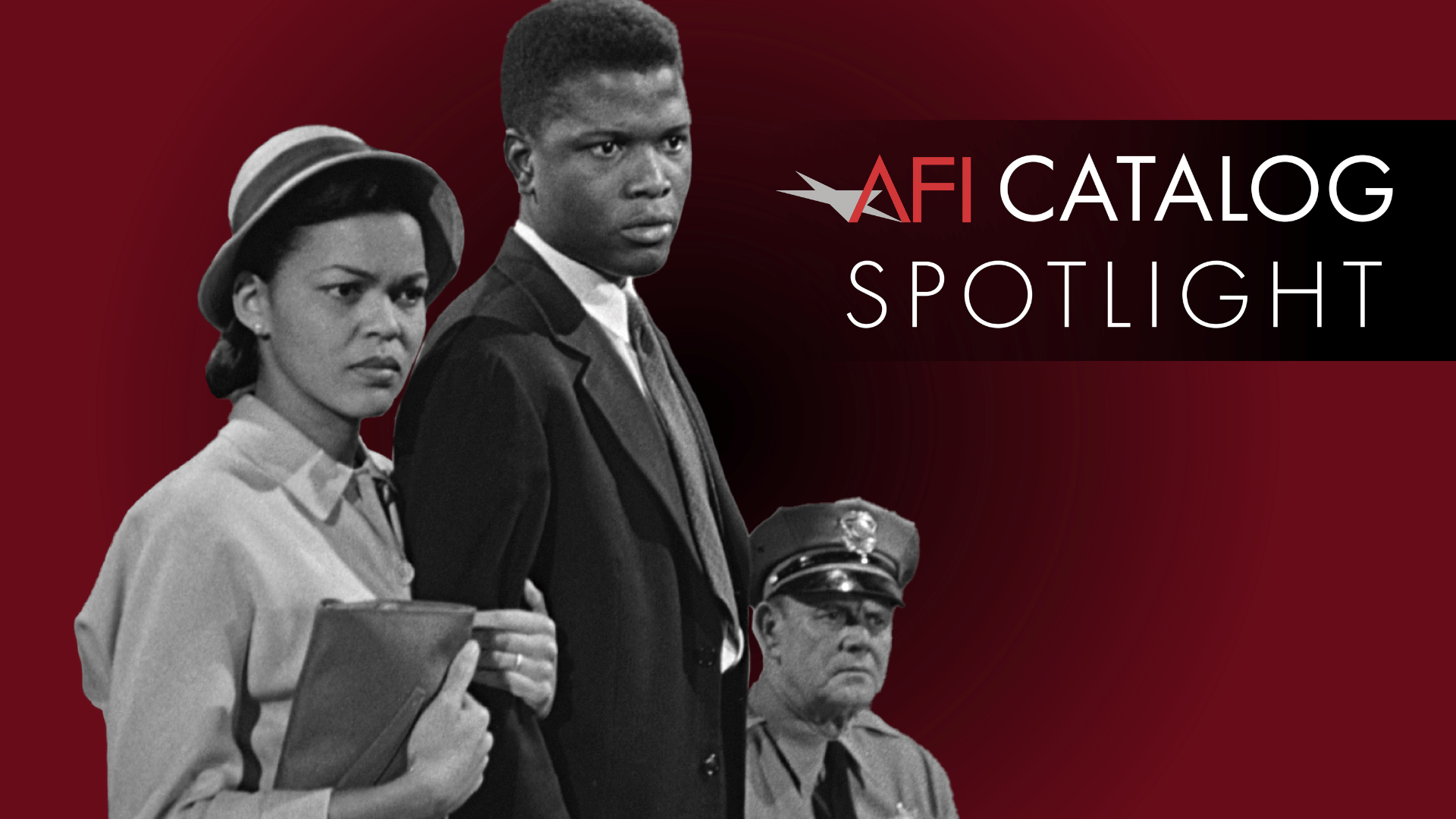
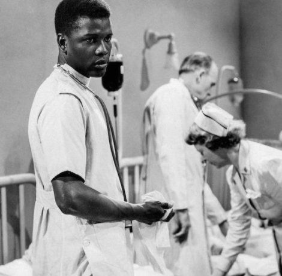
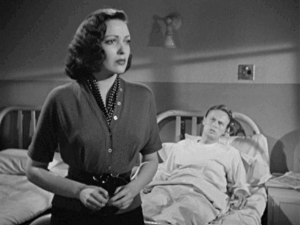
This October, the AFI Catalog celebrates the 75th anniversary of the release of AFI Life Achievement Award honoree Sidney Poitier’s feature film debut, NO WAY OUT (1950), an early exposé and critique of racism in American culture, or, in producer Darryl F. Zanuck’s words, “powerful propaganda against intolerance.”[i] Directed by Joseph L. Mankiewicz, who had just achieved new career heights after winning his first two Oscars® for writing and directing A LETTER TO THREE WIVES (1949), and was on the cusp of two more historical Academy Award® wins in the same categories for ALL ABOUT EVE (1950), NO WAY OUT (which was also nominated for a writing Oscar® for Mankiewicz and Lesser Samuels) signaled a departure from the racist tropes and stereotypes that were common in Hollywood filmmaking at the time.[ii] Poitier was momentously cast in a leading role as Dr. Luther Brooks, a middle-class Black medical doctor in an all-white hospital who fights to uphold the integrity of his diagnosis after outlaw Ray Biddle (played by Richard Widmark), the bigoted brother of a deceased patient, falsely cries murder and incites a race riot. Only the results of an autopsy can exonerate Dr. Brooks, but Biddle contemptuously refuses to authorize the procedure and Dr. Brooks must secure permission from the dead patient’s moody former wife, Edie Johnson (Linda Darnell), who slowly comes around to defending Dr. Brooks and later saves his life. Darnell’s dynamic performance nearly steals the show as her character rises to the forefront of the story and evolves into a strikingly dimensional female protagonist.
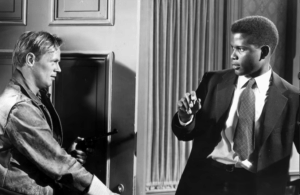
Released four years before the Supreme Court’s historic Brown v. Board of Education ruling that declared racial segregation inherently unequal and 14 years before the Civil Rights Act of 1964 finally enshrined integration as the law of the land, NO WAY OUT was met with backlash from organizations across the political spectrum who feared it would spark civil unrest. The National Legion of Decency condemned the picture and the Chicago police recommended a ban on its release. This prompted the NAACP to advocate for the film, with its executive secretary calling NO WAY OUT “the most forthright and courageous picturization of the evil of race prejudice which has yet been made…instead of inciting to riot as police censor claims [it] will do enormous good in the exactly opposite direction.”[iii] Still, the film opened in Chicago with an edited version and censored prints were shown in many states around the nation. The film did not find distribution in the South, where theaters remained segregated. After the Maryland State Board of Motion Picture Censors deleted scenes of Black community members preparing to defend themselves before the riot, and a subsequent scene showing their victory, the NAACP complained that the film’s “original message is hopelessly lost” and asked for the sequences be restored, but the appeal was denied on the basis that police found the movie to be “highly provocative and crime inciting.”[iv]
Other Black organizations, however, were less supportive of the picture. Shortly after the film’s release, the board of directors of the Negro Newspaper Publishers Association adopted a resolution to protest the use of racial epithets, and NO WAY OUT was cited as a primary example of exploitative and objectionable language in popular culture. The resolution, brought to the Production Code of America (PCA), stated that the film’s writers “err in their belief that in order to make the villain thoroughly contemptible, he and others, on thirty-five different occasions utter indecent epithets applied to the colored race. Some of these terms of opprobrium have never been heard or used by millions of Americans of both races. Their employment in the motion picture screens throughout the country builds up a vocabulary of undesirable expressions which should not be spoken in decent society.”[v] However, the PCA argued in the film’s favor, explaining that its reprehensible language was used deliberately to expose racism’s inhumanity. The fact that NO WAY OUT was quickly censored for its physical violence while being defended to preserve its hateful and violent speech toward African Americans suggests a compelling double standard in the cinematic depiction of racism in America at the time.
NO WAY OUT proved to be an incredibly daring picture for its era, both in its sympathetic portrayal of a Black protagonist, which made it ostensibly impossible to sell in Southern markets, and in its controversial subject matter, which had very few precedents to guarantee its popularity with widespread, presumably multi-racial audiences.[vi] Although Twentieth Century-Fox’s Darryl F. Zanuck was known as one of Hollywood’s most politically and socially progressive studio heads having made two earlier pictures about prejudice with GENTLEMAN’S AGREEMENT (1947) and PINKY (1949) – both directed by Elia Kazan – Zanuck found Lesser Samuels’ script for NO WAY OUT to be more forceful than the others, and wanted to produce a concise defense of racial equality without bankrupting the studio.[vii] Still, Zanuck was unafraid to push established boundaries to make NO WAY OUT more provocative. In the original script, for example, Dr. Brooks is, in Zanuck’s words, “hideously slaughtered” at the end of the story, but Zanuck ordered rewrites to ensure that the character perseveres.[viii] According to NAACP executive Walter White, Fox’s decision to make NO WAY OUT was nothing short of courageous and indicative of “a maturation of the moving picture industry [that] establishes an example which I profoundly hope that others will have the courage to follow.”[ix]
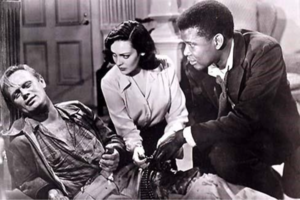 NO WAY OUT was ultimately filmed and marketed as a thriller and has since been recognized as an important and perhaps atypical installment in the film noir of the 1940s and 1950s. At the time of its release, NO WAY OUT did not fare well at the box-office with receipts of $1.35 million,[x] and Zanuck’s risk did not initially pay off, indicating that American audiences were not ready for critical self-analysis in 1950. Advertised in its theatrical release trailer as “a new high in screen dynamics which goes far beyond anything attempted before” and “entertainment that challenges your own ability to experience the emotions of others,” NO WAY OUT was not a draw for crowds outside of big cities in its time, but today its stated intentions continue to resonate as America faces unprecedented polarization.
Watch Richard Widmark discuss NO WAY OUT at AFI’s Life Achievement Award ceremony for Sidney Poitier:
[i] American Film Institute. No Way Out.
[ii] FACETS Film Forum. No Way Out. March 6, 2022.
[iii] American Film Institute. No Way Out.
[iv] American Film Institute. No Way Out.
[v] American Film Institute. No Way Out.
[vi] Scott, Ellen Christine. “Race and the Struggle for Cinematic Meaning: Film Production, Censorship, and African American Reception, 1940-1960.” Dissertation, University of Michigan, 2007.
[vii] No Way Out. DVD commentary, Eddie Muller.
[viii] American Film Institute. No Way Out.
[ix] Scott, Ellen Christine, 2007.
[x] “Top Grosses of 1950.” Variety, January 3, 1951.