

By Sarah Blankfort Clothier, MLIS, Manager, AFI Catalog
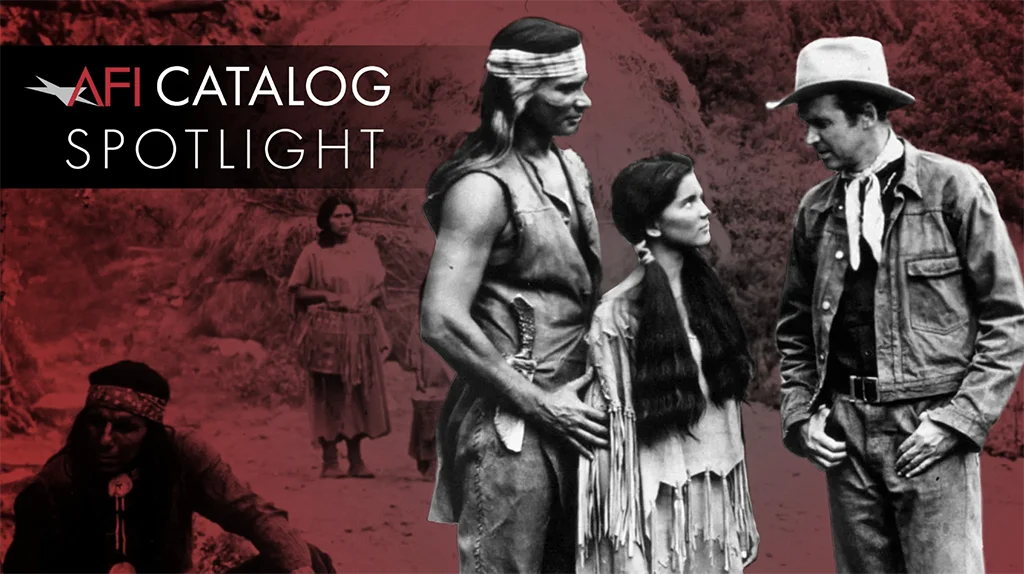
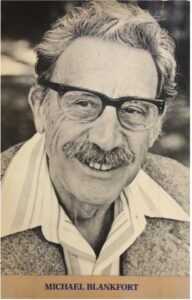
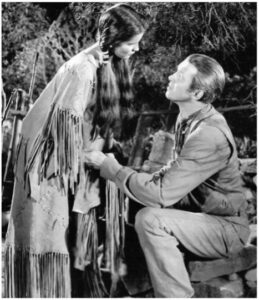 This July, the AFI Catalog shines a spotlight on the little-known story behind BROKEN ARROW (1950), which was released 75 years ago this month and is recognized as the first major Hollywood Western of the sound era to portray Native Americans in a sympathetic light.[i] The film marked a significant transformation in the way Indigenous cultures were represented in movies moving forward, and it was an early opponent of the pernicious racial stereotypes that were indicative of Hollywood productions in the late1930s.[ii] Nominated for three Oscars®, including a Best Screenplay nod for my grandfather, Michael Blankfort, and winning a Golden Globe Award for Best Film Promoting International Understanding (for director Delmer Daves), BROKEN ARROW was the seventh highest-grossing picture of 1950, earning nearly $4 million domestically.[iii] As noted by modern historians, BROKEN ARROW reflects not only America’s complex history with its native communities, but also the country’s connection to racial discrimination on the eve of the Civil Rights movement.[iv]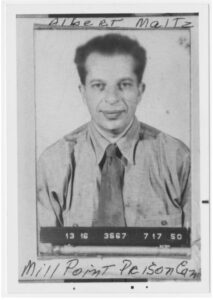
The ominous threat of intolerance in BROKEN ARROW has also been read by scholars as an allegory for screenwriter Albert Maltz’s battle with the House Un-American Activities Committee (HUAC), which ultimately left him imprisoned on charges of being in contempt of Congress in 1950, when BROKEN ARROW was released.[v] Maltz had been blacklisted from Hollywood studios since 1947 for his failure to testify in Congress about his alleged involvement with the Communist Party, and he became a member of the famed “Hollywood Ten” group of filmmakers who were later fined and sentenced to a year in jail for their refusal to respond to the fateful question: “Are you now or have you ever been a member of the Communist Party?”[vi] Since Maltz was strictly banned from employment in Hollywood, his screen adaptation of Elliott Arnold’s 1947 historical novel “Blood Brother” was prohibited from production, and Maltz appealed to several friends to supplant their names with his on the script so BROKEN ARROW could be made. When other writers refused to take on the immense risk of being blacklisted, themselves, for “fronting” for Maltz, a writer and close friend of Maltz stepped up to shoulder the liability. Michael Blankfort, who had been a screenwriter and playwright in his own right, secretly agreed to put his name and his reputation on the line for BROKEN ARROW, and the origins of the film remained confidential until 1991, after both men had passed away. Even their closest relatives were unaware of the true story of BROKEN ARROW. I remember how proud my grandfather was of his Academy Award® nomination, and I can only imagine how difficult it was to keep this deeply held secret. When considering his dilemma, I often wonder to what extent he believed his credit was due for his sacrifice and his contributions to the film, or if he was able to justify his credit because he altered the original script. Burying the truth must have taken a toll on his physical and psychological well-being, so perhaps he was only able to cope by living in denial. These questions will forever remain unanswered.
 Back in 1949, the option to produce “Blood Brother” had changed hands several times over the past two years and had finally landed at 20th Century Fox, with Julian Blaustein as producer, Michael Blankfort as the presumed writer and popular actor James Stewart as the star. Unbeknown to the studio, Maltz had already completed the treatments and early scripts for the picture, and Blankfort refused to profit from the clandestine deal, covertly turning his earnings over to Maltz. Although it remains unknown to what extent, if any, Blankfort contributed to the screenplay’s many revisions, a confidential contract between the two writers from 1948 stipulated that Maltz would complete “the major portion of the work,” suggesting that Blankfort’s input was rather limited.[vii] Trades from the time, however, reported that the script saw significant changes after 20th Century Fox’s Darryl F. Zanuck complained that Stewart’s character, Tom Jeffords, was “too noble” for success at the box-office. As a result, context was added to Jeffords’ framing voice-over narration, stipulating that the character saved a young Native American’s life because of “some crazy impulse,” and the scene of the attempted lynching of Jeffords was supplemented in the script after Blankfort incorporated Zanuck’s notes.[viii] The 1991 Los Angeles Times exposé of the writers’ private arrangement noted that producer Blaustein, who was also aware of the deal, supplied Maltz with Blankfort’s revisions for review, indicating that Blankfort may have indeed been contributing to the script and that Maltz had a role in accepting the changes.
Similar to the characters Jeffords and Cochise in BROKEN ARROW, Blankfort and Maltz were intimately close friends – blood brothers of sorts – and they had each dedicated a book to the other as evidence of their devotion. In 1952, however, Blankfort was subpoenaed to testify in Congress about his purported involvement with the Communist Party, and fearful of being blacklisted himself, agreed to stand his ground and speak. When pressed to reveal the names of other suspected communists, Blankfort mentioned that his former wife and his cousin were not members to his knowledge. The act of providing names – even though the people mentioned were not incriminated – was acutely egregious to Maltz, and he refused to speak to Blankfort again despite his many attempts at reconnecting. BROKEN ARROW marked the highlight of Blankfort’s career, as he won an award from the Writers Guild of America (WGA) for the Best Written American Western along with his Oscar® nomination. Blankfort would later become president of the WGA and a member of the Board of Governors of the Academy, all the while knowing that his highest honors from both institutions were not legitimately his own. Shortly before his untimely death in 1982, Blankfort wrote a letter to the WGA, asking the organization to credit Maltz properly, but he was unable to send it before he died. Blaustein later revealed that when he informed Maltz about Blankfort’s letter, Maltz was opposed to having the truth publicized.[x] One year after Blankfort’s death, and two years before his own passing, Maltz changed his mind and finally asked scholar Larry Ceplair to divulge his authorship of BROKEN ARROW. In 1991, the WGA voted to restore Maltz’s credit to the film and to posthumously award him with the honors previously received by Blankfort.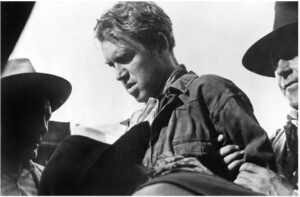
At a time in which the fundamental right to free speech in America was under significant threat and the Cold War pervasive, the ability to communicate dissent through the cinematic art form was severely compromised. It would take a precarious arrangement between two close friends to navigate the complex and unchartered circumstances that were transpiring in Hollywood. Much like the bond between Jeffords and Cochise in BROKEN ARROW, Maltz and Blankfort’s friendship paved the way for greater resilience against intolerance through the film’s message. Ironically, however, the very element of political injustice that Maltz and Blankfort were fighting against ultimately led to an irreparable rift between the two writers, and they were unable to mend their own “broken arrow” of conflict. Today, BROKEN ARROW continues to resonate as a historical testament to the era in which it was produced, and as a barometer of how history can repeat itself. On a personal note, the early years of my life were profoundly informed by my admiration for an honorable and generous man, my grandfather, who always went out of his way to bring exceptional compassion to his community and beyond. His struggle to maintain a closely guarded secret that put his greatest achievements in doubt did not preclude him from being an outspoken advocate for human rights and a true believer in the goodness of humanity. Perhaps his hidden reality only enhanced his empathy for those less fortunate and fueled his altruism, knowing what it’s like to be marginalized. I wish I could tell him today that his impact on film history and America’s cultural heritage is not forgotten. The story I’ve shared in this article will have to suffice.
RESOURCES:
[i] Angela Aleiss. Broken Arrow (Reel West Series). Ch 1: “The Screenwriter and His Front.” University of New Mexico Press, forthcoming October 7, 2025.
[ii] Aleiss.
[iii] Box Office Report. Top 15 Films of 1950 by Domestic Revenue.
[iv] Aleiss.
[v] Aleiss.
[vi] C. Gerald Fraser. “Albert Maltz, a Screenwriter Blacklisted By Industry, Dies.” New York Times, April 29, 1985.
[vii] American Film Institute. Broken Arrow.
[viii] American Film Institute.
[ix] Terry Pristin. “Mending ‘Broken Arrow’: Writers Guild Considers Award for Blacklisted Screenwriter of 1950 Film.” Los Angeles Times, June 29, 1991.
[x] Pristin.