


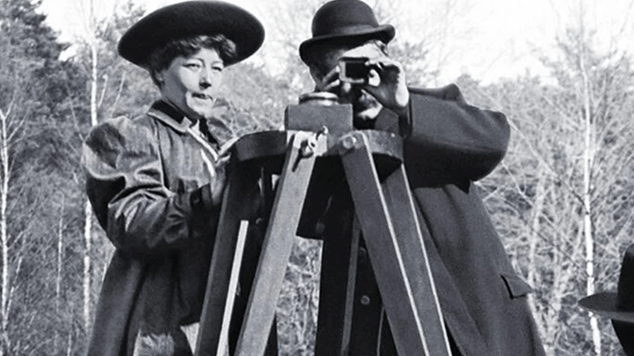
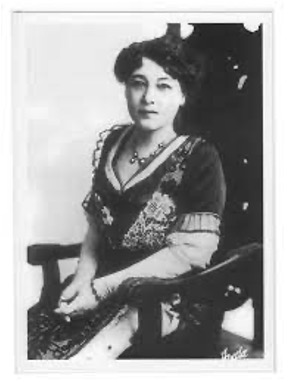
 This month, AFI celebrates the world’s first female director, Alice Guy Blaché, who made more than 700 films in a career that spanned from 1896 to 1920. Starting out as Alice Guy in her homeland France as a secretary for motion-picture camera manufacturer Léon Gaumont, she was one of the few in attendance at Lumiere’s first demonstration of film projection in 1895 and was one of the first to envision an opportunity for narrative filmmaking. In 1896, Guy directed her inaugural picture, what is now believed to be the foremost in a series of three shorts released in different years with similar themes about childbirth in cabbage patches. Guy went on to become the head of production at Gaumont’s studio until 1906, when she made THE LIFE OF CHRIST, her biggest production at that time. During the early days of filmmaking, the role of director was a little-known profession, but Alice Guy was a true pioneer, performing this duty with vast regularity.
In 1907, Guy married Herbert Blaché, who also worked for Gaumont and was sent to the U.S. to start a franchise of Chronophone—an experimental sound-on-disc system that was synchronized to the film. Guy herself was a pioneer in using this technology, as well as an early employer of hand-drawn coloring and special effects such as double exposure. When the franchise failed, Gaumont sent the Blachés to Flushing, NY, where he had built a studio, but operations again stalled. Alice Guy in turn used the facility to start her own company—Solax—with films distributed by Gaumont. Soon, the company had the resources to build a $100,000 studio in Fort Lee, NJ, making Guy the first woman to own her own film company. 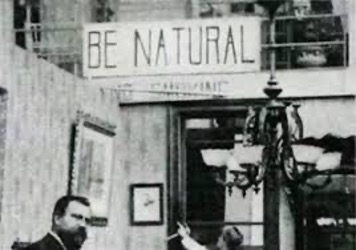 Solax remained viable for several years, producing films in a wide range of genres including comedies, action adventures and melodramas. Guy was known for depicting husbands and wives in equal roles, and for featuring female heroines. In 1912, Guy directed A FOOL AND HIS MONEY, which is believed to be the first film with an all-Black cast. The Solax studio, with its state-of-the-art glass roof, held a sign containing Guy’s mandate to her actors: “Be Natural.” This realistic style of acting was also novel at a time in which grandiose gestures were commonplace to compensate for the lack of sound dialogue.
In the years to come, feature films took over as the industry standard and studio production moved to Hollywood. Herbert Blaché responded by resigning from Gaumont, where he still served as a U.S. representative, and establishing a new company, Blaché Features, in 1913. Alice Guy directed roughly half of the films for this operation, but Blaché began yet another studio, the U.S. Amusement Company, where he proceeded to direct the majority of the productions. The marginalization of Guy’s work, and Blaché’s open infidelities, led to the dissolution of their marriage. Guy directed her last film in 1920, and by 1922 the couple had divorced. She returned to France with her two children and attempted unsuccessfully to continue her career. Guy spent her later years living with her daughter, Simone, and returned to New Jersey, where she died in 1968 with her legacy largely unknown. Guy attempted to rectify her omission from the historical canon and wrote an autobiography that was published after her death. 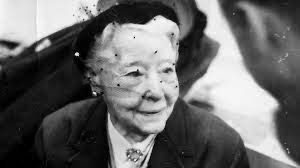 Alice Guy’s significant contributions to cinema history were explored early on in Anthony Slide’s THE SILENT FEMINISTS, a Canadian documentary, and Alison McMahan’s biography and her 2018 documentary BE NATURAL, which brought Hollywood’s attention to Guy’s legacy. In 2019, the New York Times published an “Overlooked No More” obituary which recounted Guy’s effort to find her lost films and establish her role in cinema history, an effort that was not achieved in her lifetime. A new gravestone was installed for Alice Guy in 2012, giving her proper credit for being the world’s first female film director. Feminist historians continue to bring attention to her work, and although much of it is lost, Kino Lorber dedicated the first disc in its six-disc collection PIONEERS: FIRST WOMEN FILMMAKERS to Guy’s films.