




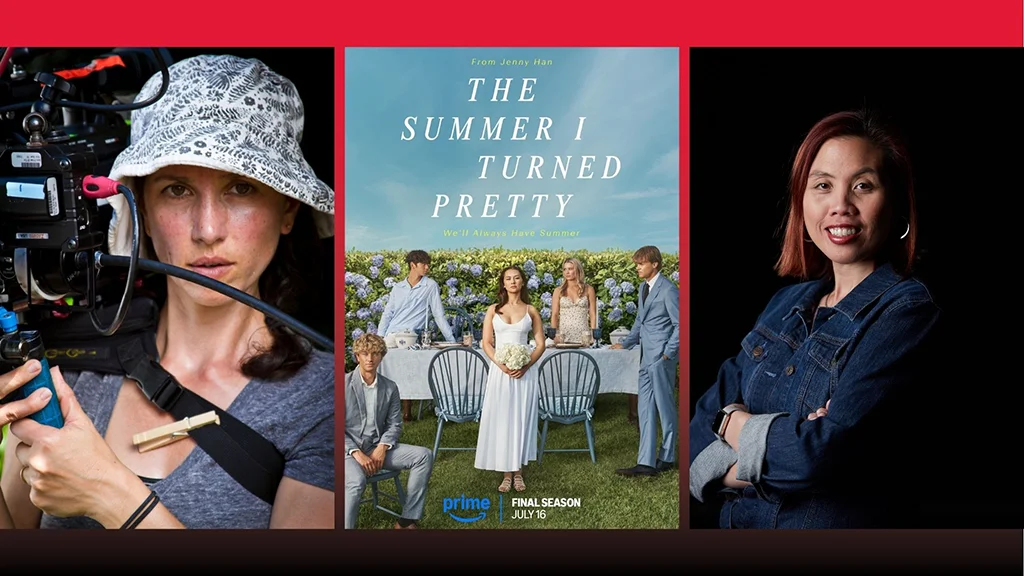
As the sun sets on the final season of THE SUMMER I TURNED PRETTY, cinematographers Tarin Anderson (AFI Class of 2004) and Sandra Valde-Hansen (AFI Class of 2006) reflect on how their collaboration shaped the show’s visual language. Their process – rooted in character perspective and honed through their shared experience coming out of the Conservatory – evolved alongside the main character’s journey, deepening with each season. In this conversation, they discuss how they maintained a cohesive look while embracing change, and the creative influences that helped define the series’ signature glow.
AFI: How did you both begin to approach this final season, and how would you say your visual storytelling approach has evolved from when you first started working on the show to now?
Sandra: When I talked to the show’s original DP, Brad Smith, he told me, “Every frame has to be pretty. It’s in the title.” That really stuck. The look was dreamy and romantic but always grounded in the main character Belly’s emotional truth.
Season 2 marked a turning point. The story deepened as the characters faced real grief and change. That evolution naturally influenced the visual approach. We stayed with the same camera and lenses, but our choices became more emotionally driven.
As cinematographers, Tarin and I focused on letting those emotional layers guide how we shot each scene. As the season unfolds, you’ll see how the visual language matures with her through storytelling choices rooted in her emotional journey.
Tarin: Each project I do, my process evolves a little. Sometimes, I will scribble on my daily shot list – “HCIMIB” – which is “how can I make it better” to remind myself to keep pushing throughout the day to make it the best we can.
AFI: How did you maintain visual consistency across seasons while still leaving room for your own creative voice?
Sandra: To maintain visual consistency across all three seasons, we stayed with the same core tools: we continued shooting on the ARRI Alexa Mini LF with the DNA LF lenses and built upon the original LUT created in Season 1. With its built-in warmth and contrast, that LUT helped define the show’s visual identity from the start.
Each season, we made subtle adjustments while preserving the essence of that original look. For Season 3, we refined the LUT to be more neutral and natural, which allowed us to use lighting and color to shape mood based on what each character is going through. That shift was purposeful: Belly and the other characters are stepping into adulthood, and we wanted the visuals to reflect that growth.
For me and Tarin, it’s never about using flashy tools or effects. It always starts with the story. We begin by asking, “Whose emotional perspective are we in?” and let that guide how we frame, light, and move the camera.
Tarin: The showrunners really liked the look of the first two seasons, and it was important to them to continue that look seamlessly. Fortunately for us, Sandra was also on Season 2, so she had a good visual foundation going into Season 3. Sandra also pulled a lot of stills that she felt represented the show. With those stills and other ones that I pulled, I put together two look books for the show, one based on previous scenes from Seasons 1 and 2 and another that had new lighting and composition references. For the most part, I felt like it was my job to continue the beautiful work that had already been established and to find places where I could light or frame in ways to add to and continue to embellish the world that had already been created.
AFI: What are some of your most influential references or inspirations — cinematic, photographic, or otherwise — that guided your approach throughout THE SUMMER I TURNED PRETTY?
Sandra: One of the cornerstones of my AFI training was learning to pre-visualize. I constantly draw from photography, art and film – using found imagery to express how light, color and composition evoke emotion. At AFI, I honed the ability to translate abstract feelings into visual language. I build lookbooks throughout the season for key moments, pairing references with written notes to clearly communicate intent to directors, showrunners and my team. It’s become an essential part of my process, something I now do instinctively, thanks to my training and experience.
Music sparks something in me. It helps me connect to the character’s feelings, guiding camera movement, lighting and overall visual approach. I also find a lot of inspiration in the cast. Their energy is infectious and watching them grow season to season has been creatively energizing.
Tarin: I looked at a lot of warm, softer and less contrasty stills and then, to balance it out, cooler, moodier and more contrasty stills. To me, one of the main objectives of the show is creating imagery that shows how the characters are feeling – I wanted to find ways to visualize the roller coaster of emotions that this show travels through. I usually start with ShotDeck and then that usually spills into other Google searches for other projects. Sometimes, I look at photography if there is a specific location or time. And when I have downtime, I love to go to museums and look at the lighting in paintings!
AFI: You both have such distinct visual voices. How do you approach maintaining a cohesive look while also bringing your unique sensibilities to the visual storytelling of the show?
Sandra: I don’t believe in cinematographers having one fixed visual voice. Our voice is whatever the story requires. That’s what I love most about this job.
Episodic moves fast, so having two DPs is a gift, not just for scheduling, but for the level of preparation it allows. Sharing the workload with Tarin meant we could each spend real time with our directors, go on scouts, have in-depth tone meetings with our showrunners and really understand the emotional beats of our episodes. That preparation is where so much of our creative voice lives, not in flashy shots, but in being intentional.
So while Tarin and I have different instincts, what keeps the look cohesive is that we’re both deeply tuned into the emotional world of the story. We ask, “How can we best serve the emotional truth of these characters?” That’s the real throughline.
Tarin: We had a great collaboration and discussed with each other upcoming sets and plans to make sure decisions would work for both people. I’d like to think that you can’t tell who shot which part when you watch the trailer because it should feel cohesive. We both believed in creating visuals that spanned the whole story arc rather than just our individual episodes.
AFI: The show is known for its iconic “summer glow.” How much of that is natural light vs. designed lighting, and how do you strike that balance together?
Tarin: “Summer glow” is definitely something we were always chasing – especially on cloudy days. For the most part, we tried to maximize time of day to optimize for backlight and having the sun in a beneficial spot. There were times when we brought in lights to help in creating an edge or a flare. In color timing, I felt like a lot of my notes were “let’s lean a little more golden.”
Sandra: We use a mix of natural and artificial light, but everything is always designed and controlled. Every day exterior is mapped out in advance. I spend time scouting locations and understanding the sun’s path throughout the day. There were a couple of scenes this season where the actual sun placement was crucial, and I would visit the location days in advance to study the light.
It all comes down to preparation and communication. I’m constantly sun pathing, talking with the ADs and directors about when scenes should be shot for the best light. I learned the power of planning from AFI. AFI taught me that good planning creates more space for spontaneity and inspiration. When everyone goes in with a plan, we can all pivot together when the unexpected happens.
So yes, that iconic “summer glow” is real, but it’s also very much a crafted illusion, designed carefully to feel effortless.
AFI: How has working on THE SUMMER I TURNED PRETTY impacted you personally or professionally? What are you most proud of — visually or emotionally — when you look back?
Sandra: Professionally, this show has allowed me to fulfill a long-held goal: telling emotionally resonant, universal stories through a distinctly diverse lens.
What I love about Jenny Han’s storytelling is that she explores universal themes: first love, growing up, identity, through characters we haven’t traditionally seen at the center. She tells honest, heartfelt stories about what it’s like to come of age and fall in love through characters who happen to be Korean American. As an Asian American DP, helping to visualize a specific and universal story has been profoundly fulfilling.
This show has reconnected me with the reason I became a filmmaker in the first place: to help tell stories I believe in, stories that reflect real life, real emotion, and real representation that many people will watch and be affected by.
Tarin: I feel incredibly lucky to have collaborated with such an amazing team and crew. I know a lot of people are really looking forward to this season and I am really proud to have been a part of it.
AFI: Both of you came out of AFI — what parts of that collaborative experience still inform the way you approach your work today and how did it shape your ability to navigate your careers today?
Tarin: Two of the most important things that AFI teaches is collaboration and always keeping the story first. I walk into every project with those two things top of mind. Let’s work together to make something the best it can be. And what can I do with lighting, composition and camera movement to support the text and the story?
Sandra: Everything I do today as a cinematographer is grounded in what I learned at AFI: from how to collaborate and pre-visualize, to how to honestly approach visual storytelling. Before AFI, I had a strong technical foundation as a camera assistant. I understood lenses, equipment and how to light a scene. But it was at AFI that I learned cinematography isn’t just about tools – it’s about emotionally visualizing the story. It’s about understanding the characters’ perspectives and using the camera and lighting to reflect their inner lives. That shifted my entire mindset and has become the core of my process.
One of the best compliments I’ve heard came from a producer who said that when they see a cinematographer from AFI, they breathe a sigh of relief, because they know that person understands story. And that, above all, is what AFI taught me: to lead with story. Everything else flows from there.
AFI: If you could go back and give your past AFI fellow version of yourself a piece of advice, what would it be?
Tarin: Take time to enjoy art that inspires you. And do stop to smell the roses, time on set makes the years fly by.
Sandra: Don’t rush the journey. Everyone’s path looks different. Some people will find success sooner than others, and that’s okay. Don’t let it discourage you. This career is a marathon, not a sprint. Hard work and perseverance pay off; sometimes in unexpected ways.
And remember, relationships matter just as much as skill. Invest in the people around you. Some of them will become your greatest collaborators. Some relationships will open doors right away; others might take years. But they all matter.


Shom
But what were your influences? Was one of them Purple Noon?