




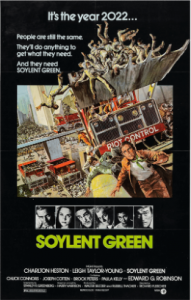
 This April marks the 50th release anniversary of the dystopian ecological thriller and cult classic SOYLENT GREEN (1973), which imagined the state of the world in 2022 with overpopulation, global warming and the vast discrepancy between rich and poor. Based in part on the 1966 novel “Make Room! Make Room!” by Harry Harrison, SOYLENT GREEN was one of the first Hollywood productions to explore climate change, mention the greenhouse effect by name and portray its apocalyptic impact for mass audiences. It tells the story of police detective Thorn (Charlton Heston), who lives in New York City with a populace of 40 million inhabitants, all vying for limited supplies in a highly polluted world depleted of natural resources. Real food is available only to the rich and most people are sustained on a mass-produced product called Soylent. Investigating the murder of Soylent corporate executive William R. Simonson (Joseph Cotten), Thorn uncovers a terrible secret which he reveals at the end of the film, declaring: “Soylent Green is people!” This iconic proclamation, which is included on AFI’s 100 YEARS…100 MOVIE QUOTES list of the greatest cinematic lines of all time, has become a mainstay of popular culture as a meme and a trope, recognizable even to those who have never seen the film. In honor of Earth Day, the AFI Catalog takes a look at SOYLENT GREEN, its predictions of life today and its correlation to the environmental movement.
Directed by Richard O. Fleischer and adapted for the screen by Stanley R. Greenburg with a $4 million budget, SOYLENT GREEN was released at a time in which activism to protect the environment was on the rise. Books such as Rachel Carson’s instant bestseller “Silent Spring” (1962) and Paul R. Ehrlich and Anne Howland Ehrlich’s “The Population Bomb” (1968) inspired readers to question their assumptions about the longevity of the planet, and to live in accordance with the natural world. In 1963, the Clean Air Act was enacted into law and by 1970, America celebrated its first Earth Day after a “teach-in” on the environment at the University of Michigan, with crowds that grew to estimates of 50,000 participants. Later that year, the Environmental Protection Agency (EPA) opened its doors with an executive order by President Richard Nixon. SOYLENT GREEN was therefore received in 1973 by a society which was prone to anxiety about overpopulation, pollution and wealth disparity. The future tense of the film in 2022, after the world suffered global warming and its blight, is filled with crime, homelessness, rampant misogyny, and of course food scarcity, forcing the masses to subsist on meal replacement biscuits served up by a mega corporation, Soylent. Humanity is controlled by corporate oligarchs, dissent is combated by piling protesters into dump trucks, and old folks, seen as a burden to society, are euthanized while watching beautiful motion pictures of nature akin to today’s virtual reality, reminding them of bygone days. One such character, Sol Roth, is performed by Hollywood veteran Edward G. Robinson in his final screen role before his death shortly after production ended. SOYLENT GREEN was Robinson’s 101st film.

Critics and academics such as Michelle Yates have noted that nostalgia for a pristine environment and peaceful civilization in SOYLENT GREEN is innately related to white male privilege and its underlying association with capitalism. The memory and longing for better times is based not on the reality of the past, but rather on a fictionalized idealization of what never was. The depiction of 2022, with its racially integrated society, is juxtaposed against the reminiscence of erudite culture in which whiteness and masculine power reigned supreme. Women of 2022 are portrayed in sexual servitude, as concubines called “furniture,” further exemplifying the film’s problematic approach to race and gender. But SOYLENT GREEN’s message as a cautionary tale was riveting to audiences in 1973, and it was a success despite mixed reviews. It won the first Nebula Award for Best Script from the Science Fiction and Fantasy Writers of America in 1974, as well as the Saturn Award for Best Science Fiction Film of the Year.
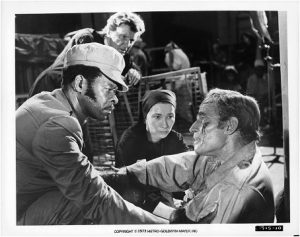 Last year, SOYLENT GREEN was back in the news as science writers compared 2022 of current times to how it was depicted in the movie, and many found that although humans have assuredly not turned to cannibalism or government-sponsored euthanasia clinics, some of the film’s overarching themes have still have some resonance. The U.S. relies heavily on fossil fuels, global warming is upon us, and the world’s population is booming, with nearly twice as many humans on the planet as there were in 1973. People are starving, while others suffer from obesity, and wealth inequality is at an all-time high for modern days. A jar of strawberry jam may not cost $150 as it does in SOYLENT GREEN, but food prices are soaring, as are housing costs, making the essentials of living challenging to attain. The acidification of the oceans has indeed caused a dire threat to marine life, as it does to plankton in the film, and the corporate elite control the world’s economy. However, today’s society reflects much more diversity than ever before, and is full of new possibilities overlooked in SOYLENT GREEN, which failed to predict the technological revolution among other prominent movements such as Black Lives Matter, environmentalism and the victories of second-wave feminism. The dystopian future of 2022 in SOYLENT GREEN has not come to pass, and the world is filled with fresh potential to build a better tomorrow. Although SOYLENT GREEN may appear dated to modern day audiences, with its painted sets filmed entirely on the backlot of MGM (one of the last movies to be shot there), it remains an important landmark in cinema history and an interesting representation of our cultural heritage.





Lura
I was glad to see your article on Soylent Green. Just last week I googled it to se if I could buy the movie. That was such an awesome movie!
It is surprising how true to life it may become. Thanks for printing this article!